


10 years of fi-compass insights - LIVE at FI Campus 2025
Watch the LIVE video of this podcast:
Main topics: Celebrating fi-compass’s 10 years, the Showcase winners, favourite fi-compass deliverables, future financial instruments, past achievements and challenges in implementation, and the innovative uses of reflows.
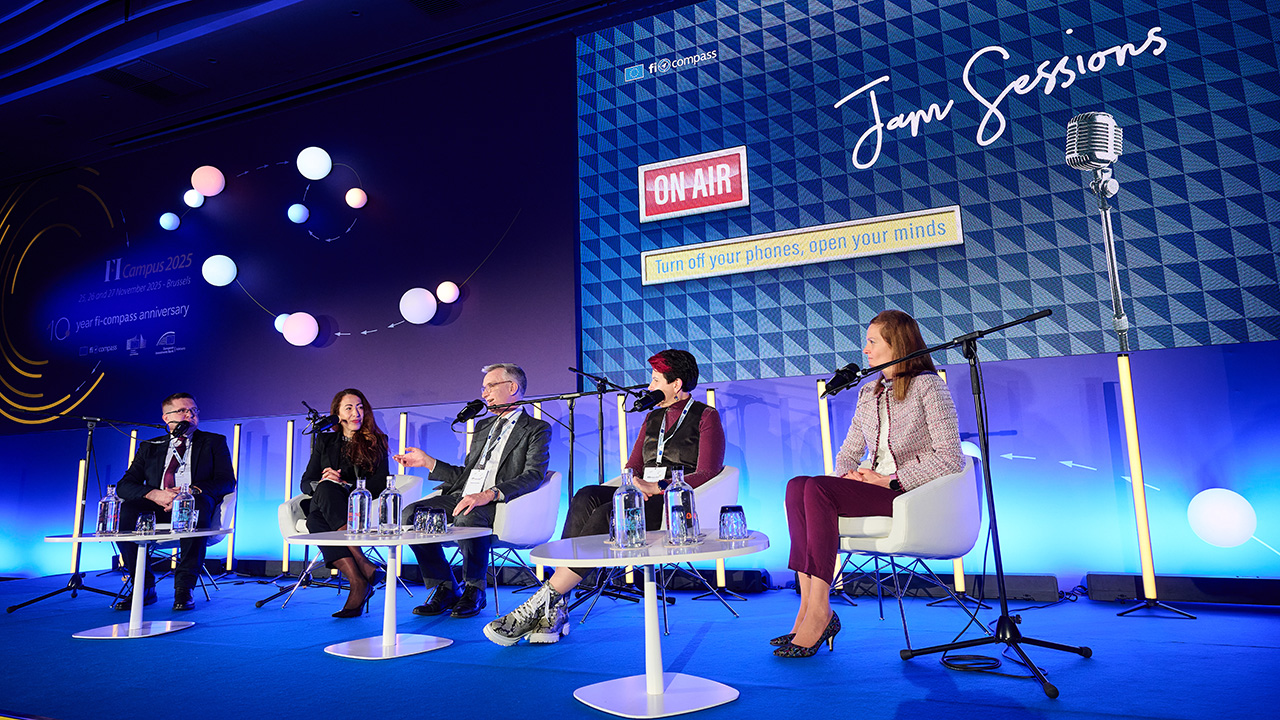
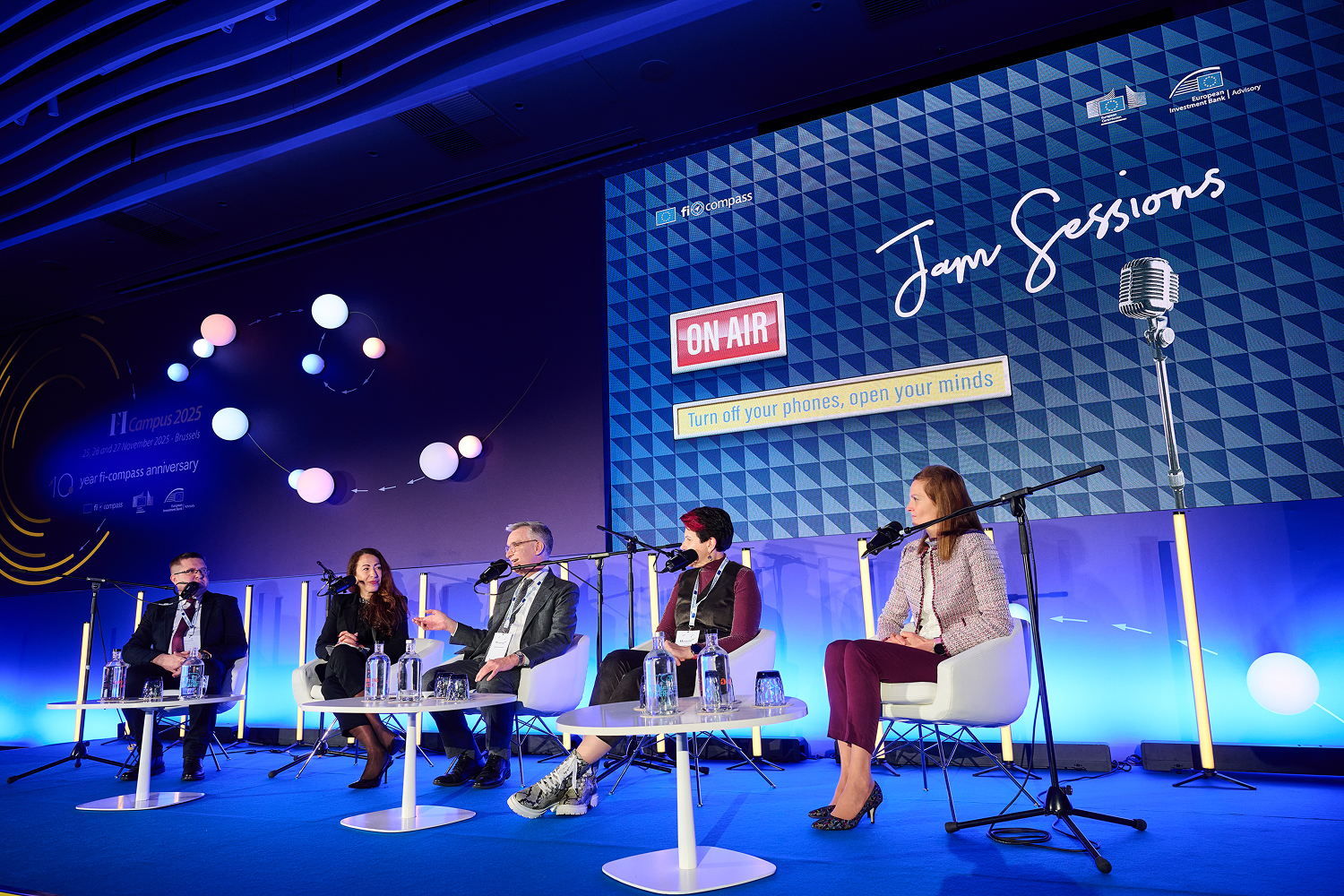
This podcast was recorded live at FI Campus, featuring expert speakers and moderated by Desmond Gardner, Financial Instruments Advisor, European Investment Bank: Guest speakers: Cecilia Gyalog, Head of EU Strategy and International Relations at MFB in Hungary; Inga Beiliūnienė, Head of International Relations at the National Promotional Bank in Lithuania; Iva Petkova, Director of the FLAG Fund and the Sustainable Cities Fund in Bulgaria; and Grzegorz Orawiec, Director in the Ministry of Development Funds and Regional Policy in Poland.




Introduction
Desmond Gardner:
Hello everybody and welcome to this fi-compass Jam Sessions podcast being broadcast live from FI Campus 2025. Thank you everybody. I'm very grateful for the applause and the enthusiasm. So, I'm also very pleased to welcome and introduce an all-star cast of financial instrument experts who have been with us on this journey.
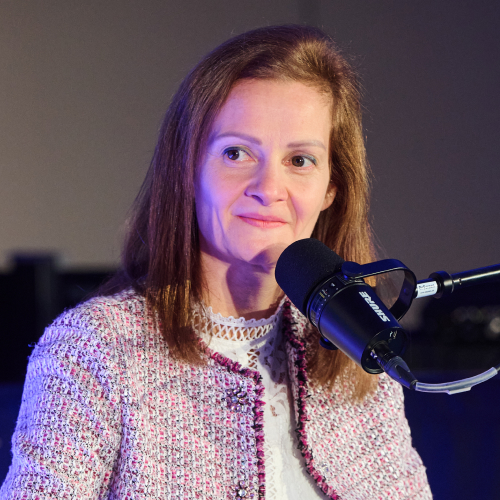
We have Cecilia Gyalog who's the Head of EU Strategy and International Relations at MFB in Hungary. Hi Cecilia, welcome!
Cecilia Gyalog: Thank you for having me.
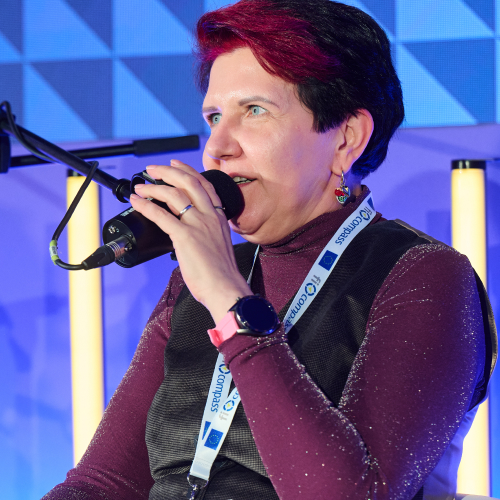
And Inga Beiliūnienė, you've met her already, from ILTE. She's the Head of International Relations at the National Promotional Bank in Lithuania.
Inga Beiliūnienė: Hi!
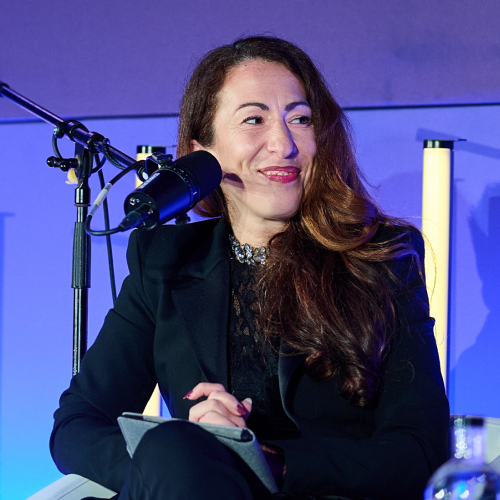
On my right Iva Petkova, the Director of Urban Development Funds department in the fund for Sustainable Urban development and Fund Flag in Bulgaria.
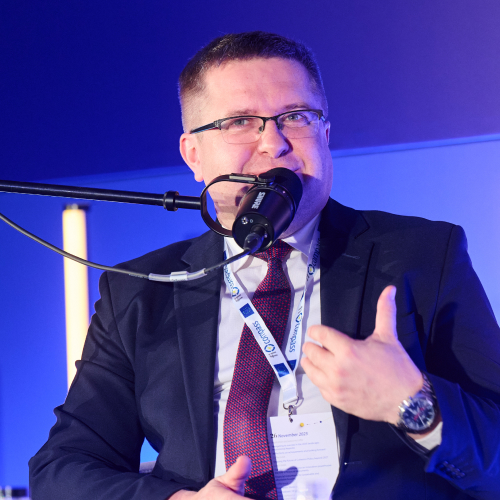
And then we have Grzegorz Orawiec, who's the Director in the Ministry of Development Funds and Regional Policy in Poland.
Desmond Gardner: Welcome!
I can put my paper down now because I've done the names. So, thank you everybody for coming today. I think we want to spend this time reflecting on what we've heard over the last two days. It's been mentioned once or twice, but I'll just say it one more time - this is the 10th anniversary of fi-compass. And, I think we've spent the first day looking back, what we have achieved perhaps over those years. And then today we've been more about looking forward. So we won't do a similar structure for today's session. But firstly, we've just seen the Showcase Awards. We've had three projects that have just been given the prizes. So maybe we can just say something about that. I'll turn to Iva first because she was one of the winners with the Urban Development Fund in Bulgaria! So any thoughts about that?
Iva Petkova:
We are in fact winning for the third time, this award. And I'm very happy and delighted with our colleagues that took part in the pitching session. And it was fantastic success. Thank you very much to all of you!
Desmond Gardner:
Thank you Iva and well done! Congratulations, it’s not the first time you've won either! I think it's good to see urban development being recognised. Maybe Inga l can ask you about the Social Impact Fund in Rotterdam, because I know you looked at social impact in the past in Lithuania. So perhaps you can say a few words about that?
Inga Beiliūnienė:
Actually, it was one of my favourites, to be frank. Also, I voted for another one. I voted for Cultural Heritage, but the Netherlands case was the favourite because it's actually social impact. And I was speaking about social impact yesterday. So this is you know, a story which is kind of reflected in Netherlands. So it's very good -a good story and a good case.
Desmond Gardner:
Yes. It's nice to see it recognised and it's surprising for me how often social impact is mentioned now, in the context of financial instruments. It's definitely an area where it's having impact, and I'm sure that's going to grow in the future. And maybe Cecilia, you were an unlucky loser, I'm afraid, because there was a nice innovation example given from Hungary, which was really good. But it was the Bank Português de Fomento. But maybe you can say a little bit about Innovation and that submission.
Cecilia Gyalog:
Yes, I think the Portuguese was also an example of a very smart, innovative, support team. So we very much liked that project. Also, I must be not biased with the Hungarian one, but let me mention to others the one that is the La Reunion. I'm sure I did not pronounce it well, but still, I think that that's something symbolic of a simple but very smart. It's targeted this far as I understood, through the eligibility criteria, but it's very simple for the final beneficiaries. I'm really very glad that I could hear it. And the other one is the Urban Development Fund from Bulgaria for the cultural Heritage. And, what struck me really is that they managed to include 40, that's 40 percent of private funding for cultural heritage projects. And I think it's amazing. So, congratulations!
Des: Thank you, Cecila. And it's nice to see urban development coming up the agenda. And there's a number of urban development financial instruments in Poland as well, Grzegorz it's an important type of operation in Poland, I think as well, isn't it?
Grzegorz Orawiec:
Yes, definitely. Thank you for this invitation. I’m happy to be here and to look at different categories and the winners. Always, I have to say that innovation is close to my heart. So when I heard this category, I kept my fingers crossed for everybody. And I'm happy that, we can see such projects develop with the colleagues from DG REGIO because I'm sure that this just needs a collaboration that needs this formula that because we sometimes think in a tricky way that innovation means we need grants. No innovation needs really good support. And complex support. That's why its great to hear about these products that's in this category.
Desmond Gardner:
You're absolutely right. And so, thank you. And maybe if I can just add my congratulations to all 13 people who came up and pitched yesterday. It was so impressive, it was and very well done to you all. Definitely some new faces. One of the things for us at fi-compass is identifying these success stories and these stories that we can highlight through our deliverables and there were so many good ideas yesterday. So it was really great. Thank you very much. Right, okay. So now let's move to the next topic, which is sort of looking back at fi-compass and how it has helped us over the last ten years. I think we've heard, some good examples yesterday, but maybe some more personal stories from the panel now - how you've used your fi-compass deliverables. So perhaps Iva, you could tell us, you know, which of the fi-compass deliverables have helped you in the past?
Iva Petkova:
For my colleagues, for our team, for the Fund of funds, I believe the publications were the most invaluable tools by the fi-compass, especially those that were developed for a single operation combination. These for energy efficiency, under REPowerEU, and for European Bauhaus. Both were an inspiration for the new urban development funds that were structured in the 21- 27 period. They offered quite clear structuring logic and implementation pathways that allowed us to be tailor made for our growing needs. On my personal part, I'm really delighted with the fi-compass community. And, it is a moment of the ten-year anniversary, but I have really found here a lot of friends, a lot of colleagues, too, with whom we've shared common problems. But also, we have found common solutions to these problems and the participations in the knowledge hubs, in the energy efficiency scale-up initiative were really invaluable for me, and for my personal growth and for the growth of our funds, because I'm sharing all what I have learned with my colleagues. And, this is a really the power of the fi-compass community.
Des:
Yes, it's a great network, isn't it? And I'm glad you like the publications, because it's such an effort really, made by both my colleagues in EIB, but also the team of the European Commission to produce those documents and get them right, get input from other parts of the commission, like DG COMP, who are always very cooperative. So it's good that they're useful. I think people really do go the extra mile to make them helpful in that respect. Maybe, Inga I'll turn to you now and maybe you can tell us a story.
Inga Beiliūnienė:
I have two favourites, actually, where the first one is Knowledge Hubs. I had the honour to participate in them. And my colleagues also participated. And actually, when you see the rules and regulations written in simpler words with a lot of examples, it's very, very useful. And I was reading them many times, and I was even using them for trainings on financial instruments, you know, what does it mean? So, when I was explaining specific, regulations, rules, etc.. So this was this is a very, very useful tool, which has to move forward. Another topic which, actually I like very much, not the topic, but the situation or idea or actually the -it's not a presentation on the screen- It's actually the talks during the coffee breaks, during the lunch break or during the dinner when you can speak to the practitioners, when you can learn from them and to understand all the details, because, you know, the proverb, but “the devil is in the details”. So, actually you must understand them. And it's a very, very useful tool.
Desmond Gardner: And it's great that people made themselves available and we can have those conversations afterwards, isn't it.
Inga Beiliūnienė : Yes, yes.
Desmond Gardner: Yes, it feels more and more like a reunion these days. Picking up on what you're saying. Maybe we should have an event without presentations and just talk!
Inga Beiliūnienė : Coffee, food and wine, frankly.
Desmond Gardner: That would be a nice thing! Cecilia, what's your thoughts?
Cecilia Gyalog:
I think I firstly, I would also mention this remarkable live network of professionals who are extremely experienced and very innovative. That’s the first one. I would choose the second one, the thematic workshops. I think these allow us to get to the nitty gritty of some special issues on financial instruments. These are very useful, I guess, in the audit operation. As a third one I would mention my personal experience, that was a few years ago at FI Campus when the auditors, for first time, came to the stage and explained to us their views on the implementational side. And I think it was very instructive for the audit operation.
Desmond Gardner: Indeed, yes, the European audit team at the European Commission have been very open and helpful with us over the years. We did a really good knowledge hub on that as well, didn't we! So yes, I know it's definitely a really good thing. Thank you
Grzegorz, you've seen this from both sides. We should say as well, shouldn't we? Because you did spend some time in the Commission, so what are your takeaways?
Grzegorz Orawiec:
Yes, that's why it's challenging to me when I compare this but my favourite one is the case studies. Because for me the study of fi-compass - it's the study of real case studies as presented here, your projects and everything what we do, what we plan as, let's say, policymakers, managing authorities, however at the end, and at the beginning there should be case studies. So when I look at this, when I compare from different approaches (ERDF, ESF, Rural Development Fund, I always think, oh it's possible, they did it in some country regions. So how can we to do it? For me, its like a bottom up approach when they feel inspired by these stories. So it's great to hear and see this. I call this a cross inspiration - that we can inspire together, as the managing authority, as the operator, so there is that level when we see these case studies. And then I think that we believe that we can break some barriers because somebody says at the beginning – “No, no, no, it's impossible”, but yes, it's possible because somebody already did it in some countries. So, for me it's great. And the second that you mentioned about the great community, about this inspiration during each coffee break, each lunch time, however, maybe it is a very innovative proposal. Next year there should be only, such an open meeting in the office that we can try. What about the results? Even during the last break, my colleague Andrea just inspired me talking about this – what did we miss? Maybe we miss, for instance, that we need new commerce, more new commerce. So is our family of the financial instruments, they will be supporters, will be ambassadors of this instrument. So each such talks or meeting is very inspiring.
Desmond Gardner:
I think that's right, I know, and the point about the newcomers is great. And I think to some extent those pitches were an example maybe of some of the real rising stars, maybe, it's the thing we need to capture those, and do more. So yes. Thank you for that. And that was really helpful. Okay. I'm going to now take a chance and I'm going to go and ask the audience, whether anybody out there would like to share a story or an example of how they've used a fi-compass deliverable. There's no obligation if you don't. But if anybody does have anything they want to share on the podcast and then raise your hand and we can get a microphone to you. I'm looking around and everybody's watching me very interestedly, but doesn't look like they want to share anything at this stage. It's fine No I'll do Anna’s thing- Three. Two. One. No. Fine. No problem. We'll move on.
We'll move forward and we'll talk now about what lies ahead. Both in the long term, because we've been talking a bit about the next MFF and all of that, but also maybe the shorter term as well, because I think you're all in implementation mode, aren't you, for the current programming period. These instruments are often only just getting underway. So maybe you can share with us some of your plans, what you expect to achieve and what your hopes are for the future. Grzegorz, I'll go to you first.
Grzegorz Orawiec:
Thank you very much. In Poland I think that we just now have this a big question mark, how to redesign the system of support for innovative economy and for competitiveness, because I think that more of member states now, at the beginning, we always think about grants, classical support, but now we want to concentrate more on financial instruments and leave the space for the highest innovations for this breaking through solution, as the grants are really added value. And just, not to say in a negative way, but in classical way, our typical development and competitiveness should be supported by financial instruments. So we try to design out the system. We propose in our programs new tools like for instance, the green and digital financial instruments or other aspect like this. And they hope that the market will be interested in this. So, this is our main challenge to build really a system for many, many years. It should be not only, of course spending not only investing, it should be really a very wise long term investing on this capital. And we work just now on this that I hope that we then make this stable system because as you mentioned, sometimes now is living from one perspective to another. And question of the market will be no less. But for us, this financial instrument should be just natural transmission between them and making these stable connections. So I hope that maybe we can present in the next FI Campus some solution on this. But Poland is quite a big country. So also the challenge is how to combine it together at the national level and 16 regions. And we have at least 17 managing authority in the system. So it's great in competitiveness. But on the other hand we try to make good coordination.
Desmond Gardner: No indeed you mentioned case studies earlier and we did a great case study on the Biznesmax instrument a few years ago. And one of its priorities is innovation, which of course, we've been talking about. You mentioned, I mean, how is that going now? Is that going further? How's Biznesmax?
Grzegorz Orawiec:
Yes, thank you. Great that you mentioned this. We are happy that the Biznesmax is really growing. We plan to allocate another amount of money from program to this system and to generally guarantee funds are very well developing in Poland. And I can say maybe a little bit, going ahead in our plans in Poland and even from Polish RRF we plan to make some movements through Invest EU and prepare another guarantee system for SMEs. So for us it's, I think, really good, success story. And I hope we develop this because the market is really interested. They need just stable and clearer rules for financing. Maybe nothing special, but it's still this basic. Give us the clearer rules and we apply. So, in Poland we can confirm that it's working.
Des: Yes great, thank you. Iva maybe I'll come to you next. Maybe you can outline what happens next for the award winning urban development fund in Bulgaria?
Iva Petkova:
In 2026 we are starting in fact, the implementation of three, I believe, financial instruments, Fund Flag was awarded the financial instrument in the water sector. So it's the most imminent one. It's a risk sharing, relatively small instrument but we have a quite strong pipeline, and we will do our best to perform it in a very good way in the next year, we have also under the framework of Sustainable Cities Fund, take part in the procurement procedure organised by the Fund of Funds. And, there being an audit, guarantee financial instrument, with combination of supporting one operation for a circular economy and energy efficiency of SMEs. And it's quite a big one - €300 million. And we will deliver it, I believe, in the first quarter of next year. So it is a very challenging one. But we are working very closely with, our partners from United Bulgarian Bank, and we believe it will be a very attractive instrument for the SMEs. And last but not least, of course, the urban development funds, these procedures, this time, took a lot, a lot of time. And, we have been selected to manage the two urban development funds covering the whole Bulgaria this time. But still, there are ongoing proceedings, legal proceedings. So we are waiting for the final award, but we are ready to start with a very viable pipeline of projects.
Des:
Okay. That's great. No, no thank you! And maybe I should just say we haven't scripted this, by the way. I said we would do this to keep it, but one of the things that you did, which goes back to maybe a session earlier today, is in Fund Flag. You also have the benefit of an EIB loan as well, don't you. And you use that alongside your urban development funds. Do you want it maybe describe how you do that briefly?
Iva Petkova:
Yes. It's called the Bulgarian Investment and Coordination Platform. It was set up in 2020 as a complementary mechanism to the urban development funds. And back then we have concluded the first contract with the EIB and it was a blast, a lot of municipalities applied. And in less than a year, we have engaged all the available resources. So we have concluded the second finance contract, and we are still in process of utilisation because a lot of grant money has been poured out in the last couple of years. But we are still going strong with the platform.
Des: Thank you!
Cecilia, I'll turn to you now - Hungary like Poland, in fact, two of the largest users of financial instruments in the EU. So what are your plans for the near and for the future?
Cecilia Gyalog:
So first of all, of course we have to implement those that are under this programming period. We already have seven loan programs, which are already on the market. We will shortly start with the venture capital programs. And we are targeting again, many fields such as SMEs development, energy efficiency, renewable energy, digitalisation. We are doing three types of combination in one operation. So, targeting different types of final beneficiaries. And we allocated again more than €2 billion to financial instruments. So we are trying our best to secure the 2029 deadline.
Desmond Gardner: Great. Thank you. And Inga, what are your plans?
Inga Beiliūnienė:
So actually to implement what we launched already several years ago because, you know, we are not planning to launch new instruments next year using structural funds, EU funding, you know. We have a quite a variety of instruments. Some of them are implemented directly by us. In this case, we are talking about direct loans for, digitalisation of industrial companies. Or innovation in business. In some cases, we have instruments which are implemented by financial intermediaries. And in this case, I'm talking about equity funds. We also have instruments, which we launched, in the agriculture sector, energy efficiency, renewable energy, energy efficiency in public infrastructure and public sector. So actually we have to deal with this and we have to show the results. And some of them are showing really good results. And it's a blast to kind of really a success. In some cases we have to do much more in publicity. Just to sell those instruments because they are quite new. Especially, for example, in R&D. When we are providing direct loans for R&D projects, which is very, very new. And, you know, in this case, we wanted to switch from grants, which is very often used for R&D projects to lending activity. And the clients have to understand it and have to finally decide that, okay, I am not going for a grant, but I'm going for a loan, which is repayable financing. We have already results showing that the clients we are adopting to this and they are understanding that the loan is not something which is scary. So they are coming to us and we have increasing results. But of course we would like to show, to see better uptake. But you know it takes time.
Desmond Gardner:
Yes. No, that's interesting. And we presented an innovation and housing model earlier today. And in both of those, people talked about changing the mindset and the need to change the mindset. And I think that sometimes with our senior decision makers, but it's also with the market, isn't it? Also with the potential final recipients who are maybe accustomed to receiving grants and changing the mindset amongst that community in terms of what the benefits are.
Inga: Yes you have to show candies, we call it candies- so carrots, you know.
Desmond: But actually candies are better than carrots. You know you won't go far for a carrot will you really!
Inga: If you are a rabbit you will!
Desmond: Yes, okay.
Inga Beiliūnienė:
But you have to put some candies and the candies on the ground. So actually, in the R&D type of loans, we have very favourable interest rates. For the first three years they are zero- the interest rate is zero. Actually, for the rest of the loan duration of the term, it's 2%. So, you know, if you achieve results or KPIs that you agreed with us. It's a direct lending instrument. You can receive a capital rebate. So it's fantastic conditions. And when the companies start to realise that these are these conditions are very very good. They are coming. So we are seeing the increase, step by step increase in the results and we are happy about that. But it takes time. You know and with the programming periods we have a limitation. We have an end of eligibility period, which is kind of tricky in case of pilot financial instruments which are sold during several years, it's not possible to sell everything, to sell the loans in one year. And with a pilot instrument. So you know, the end of eligibility period - it's a challenge. But we have to be seen to do something. Otherwise we will stick with the instruments which is nothing new. Which has no pilot, you know.
Des:
You almost have to act like an entrepreneur, don't you. And pivot if things aren't working. And we heard that yesterday about experience. People often have to look or review the financial instruments and repurpose them and target them slightly differently. And then suddenly they fly away and they have huge success. And I think that's definitely a thing that we've heard several times. I mean Cecilia, I don't know, is that is something that you've experienced in Hungary as well, in terms of that need for flexibility?
Cecilia Gyalog:
Yes, I think we believe in the broader project. So the broader. the simpler is it to adapt to the market needs. And of course, we continuously modify it, based on the inputs of the market on the demand side. And we try to keep it as flexible as possible. Yes.
Desmond:
And I know we've heard several sessions about reflows and the use of reflows, which is something we don't really talk about a lot at FI Campus, but I think, have you got – has anyone got a story about reflows they want to tell me?
Grzegorz ?
Grzegorz Orawiec:
Yes exactly, its me. I have one that I think it's really important. It's a little bit personal to me and to my team. We are together with my team because the reflows, as you mentioned, in our opinion. Okay will only be an increasing topic because we hope to have more and more reflows. So, it's good information. But what I would like to share as, some case study from Poland and hopefully next year we can develop it, that when you look at the, at the this reflows from the point of managing authority, we decided to one year ago to, let's say design totally new instrument. We call this just -Ukrainian loan. But in practice it means the loan to the enterprises that operate in Poland. And they would like to participate in rebuilding of Ukraine and building business relationships with Ukrainian partners. And it was really a huge challenge to us. We started from the ground zero one year ago. We said how do we do it, but step by step, analysis, some assessments, investment strategy together with the Polish, of course, state owned bank, BGK. And we are happy now that we are operating this. We allocated €50 million for this, let's say first round. There is high interest of potential, beneficiaries of companies. We are happy to offer them two and half million euro for ten year loan with very attractive conditions. And so we did just, I think, quite a scope of support for the storage, logistic and the equipment machines for business contracts with Ukraine partners. And you see we were really afraid to be honest if anybody will apply because it was nothing at the market before. And now we see that they were overbooking. So we planned, let's say a second round probably and this is the satisfaction. When you mentioned reflows is a tool but this is real satisfaction that you already designed something totally new, you'll take this risk, and at the end - I know that you all know this - you'll see it's working. You checked and it's worked. So we are happy about this. And reflows and financial instruments could be a great tool for such a new approach, even cross-border, even internationally, in this positive way, starting from regions or from the countries. So this is our Polish story about reflows that I hope we will develop.
Desmond Gardner
Wow. I mean, that's amazing. I mean, there's always something surprising, but that's a great story. And what a great use of reflows. And it goes without saying that that would never have been imagined when the programming period from where those resources came from. And it just shows the power of financial instruments and the importance and congratulations! Because I think that's a very creative use, you know, that's a great story. Okay. I'm going to have another go and see if anybody from the audience has any questions. Because I'm an optimist, anybody would like to ask a question to the panel, if anything they've said or anything else? If not, I think we'll move to the, oh, there's, I see a hand over there.
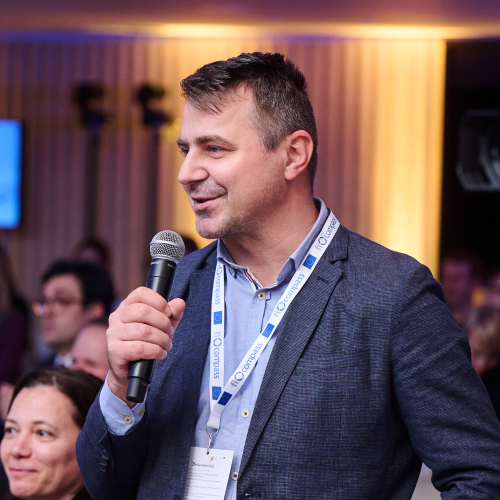
I have a question for all of you. Have you ever encountered a situation where you launch a call for expression for the interest to select a financial intermediary, but on the deadline, nobody submits a proposal. And if yes, what have you done to tackle the situation? If you’ve had this situation?
Desmond:
Maybe Inga? Do you do calls for expression of interest?
Inga Beiliūnienė:
We do, yes. And we didn't have such situation. We always receive applications. It can be one application or it can be several, you know, even more than ten. But, what would you do? You have to relaunch it? But you have to talk to - I don't know whether it was a real situation in your case- but when you are launching an instrument or preparing to launch an instrument, you have to talk to the market. You have to talk to the potential financial intermediaries. You have to understand their wishes and their demands and what they need. And your instrument should reflect the needs of the clients, of the final recipients and also of the financial intermediaries. Otherwise they won't come. So, talk to them. Listen, ask why they are not coming and then relaunch it.
Desmond Gardner:
Yes, I think somebody said yesterday, didn't they, do something quickly and get started and maybe listen to the market and try and recast it and go out again I think. Yes. Keep going I think is probably the best example.
Grzegorz Orawiec:
Yeah definitely. I can only agree and support to come back even to some assumptions. The starting point, what are we going to achieve. And as you mentioned, one point about the market expectation and the demand- we should be always demand oriented, not otherwise. But the other hand, of course, probably I assume these parameters for operators, for intermediate bodies because they are always interested. It's just a business about the conditions. So you have to look at this from both sides and come back to the investment strategy, and for sure, relaunch. And I'm sure that at the end there will be interest in money and the conditions.
Desmond:
Yes, thank you. We'll go to our final question then for the panel, which is just to tell us a story. Yes, tell us something interesting that has happened to you in the world of financial instruments, in the last ten years. So maybe, Cecilia it's a challenge, but I'll pass it on to you first.
Cecilia Gyalog:
I think I would mention one product we implemented, and this was a Covid response loan product, a single product. As we just mentioned yesterday, the financial instruments prove to be an efficient tool to manage the downturn after the Covid crisis. And what we managed to do is to set up a small working capital loan programme in two months, and it was basically a big success. We got more than 13,000 applications. It was not a big sum, but I think, there is the saying that “who gives first, gives twice”. And I think this was this example because we reached many service providers over the advice and that's around the crisis. And there are many times, really in my private life, when I go to a service provider and there is this communication board on the wall, and they are asking, “what are you doing as a profession?” And I can just physically point at that.
Desmond Gardner:
Okay. Really cool. Yes, that's really nice. It's always nice to see the benefits of your thing. So thank you for that. That's a really nice story. Maybe Iva, is there something that you're particularly proud of or that you remember?
Iva Petkova:
I always recall my first participation in FI Campus in 2018, when we have been invited together with the fund of funds and the other financial intermediary that was selected. But we both have implemented Jessica funds, and they were such a small pilot fund back then. And we were driven mainly by 5 to 10 people which gave a lot of dedication, a lot of work. And since then, our team grew, our partnership strengthened. The scope of these instruments have grown tremendously. But what is still in my heart is that we are seeing the same spark in my colleagues, and that is driving us forward to make more and more. And I'm still finding this job very, very exciting and inspirational.
Desmond Gardner: That's great. And thank you. And I think you reflect the passion for a lot of people out there in the room as well. I'm sure that resonates very much with them. Grzegorz?
Grzegorz Orawiec:
Yes I also discover, let's say, some years ago this, that financial instrument means just passion. And at the time I was working at the beneficiary side, you know, on the foundation, it was a local foundation in Sandomierz, its south-east Poland. And Sandomierz is a great tourist destination, just a small advertisement, a small realm you should visit! But what I was really impressed by - this foundation applied to Swiss contribution fund. This is also this tool that you can get allocation for financial instrument. And based on this, they start to offer small or microloans for a local community. And I was so, shocked in positive ways that it's not about the money, the amount of money. It's exactly - it's about the passion about this to be proud of the local tradition. Some heritage, like they want to rebuild local vineyards, they want to promote local, food, etc., etc.. This local small entrepreneur, I was shocked because this microloans it was at the time €1,000 maybe I said what to do with €1,000. No- they did miracles! So based on this as I was on the side of that and now I understand it's not about money, meaning even if you talk about money, but at the end or at the beginning about passion. And for me, it was so positive, that I saw that they changed the local reality. You can touch this, project by project. So I stay with this and I think about what happened then I said always it's not about these limits.
Desmond Gardner:
I like that especially coming from somebody who through instruments like Biznesmax has got really massive guarantee operations as well. But no, it's a very good example. But that social impact, that local impact that these instruments can have. No. Thank you very much. And, Inga, I turn to you finally. Is there anything you're particularly proud of in your many achievements?
Inga: Two things I would like.
Des: You can have two things today!
Inga Beiliūnienė:
One thing is actually, I remember the trial took, during the Lithuanian presidency, I was invited in the negotiation group and I saw how the trial was going on and how the negotiations were going on and the regulations. There was a kind of surprise at that moment. I was really helping the team leader to negotiate and tell him how to do that. And it was, I will tell the personal feeling, it felt like at the market when you are going to bargain for the sausage or something like that, for the vegetables. And when you're giving somebody, “Okay, I'll give you this, and you will give me what I want” and, when you see, the provisions written in the regulations which you were negotiating on, and when you read the text which you were proposing, you know, I am proud of it!
Another thing, I remember the very beginning of the use of structural funds. At the time, I was working for the Ministry of Economy in Lithuania. And the vice minister at the time believed in us. We were very young, and I sound like a dinosaur, we talked about dinosaurs, yesterday, but…
Desmond Gardner – I deliberately did not use that word! I think I said experts didn't I!
Inga Beiliūnienė:
Let's call it experts! So actually, at that time, we were using only a small amount of national money for guarantees. And we were young and brave. and were thinking of how to expand the financial instruments. And we managed to persuade our bosses, you know, our authorities, to allocate a €80 million. And how it was done, actually, it was not Euros (I don't remember if it was national currency or euros), but the amount was €80 million. So actually he told us, “Okay kids, this is for you to play with”. So, what I am proud of is that we had an initial allocation of €80 million at the time, and now we have billions of euros in financial instruments. This is something which I am proud of. It took time, but now we have a result. We have an effect. We have reflows and we have clients who are happy about using the financial instruments.
Desmond Gardner:
It's a great story, and 80 million! (Is it 80 billion? 80 billion!) That's amazing. That's a great way to finish, I think, the podcast, I think we've done a nice job in maybe trying to give a flavour, at least for people who are listening, to the themes that we've been discussing over the last two days. We've got another day of FI Campus to go, of course, tomorrow with our parallel sessions and everything. So we look forward to that. And there's a small celebration as well tonight for our ten-year anniversary.
So, I'll just finish by thanking the panel, Cecilia Gyalog, Inga Beiliūnienė, Iva Petkova and Grzegorz Orawiec, and thank you very much for giving us your time, your interesting stories and everything else. And I'll just say thank you, everybody. We have a standard way of ending our podcasts, but I haven't got my script handy, so I'm not going to be able to do it! All I will say is, we look forward to tuning into future fi-compass Jam session podcasts in the future. And thank you everybody. Have a great rest of the FI Campus 2025. Thank you very much.
Relevant links for this Podcast
Showcase Award 2025 :
- FI Campus Showcase 2025
- From Vision to impact: the growth of urban development funds in Bulgaria
- Constructive collaboration with Social Impact Funds in The Netherlands
- Banco Portugues de Fomento: Capitalizar Mais Guarantee
Publications:
- Implementation of grants and financial instruments combined in a single operation
- Model for a financial instrument with a grant component to support energy efficiency
- fi-compass Knowledge Hubs
- Audit methodology for auditing financial instruments, programming period 2021-2027
Case studies: